

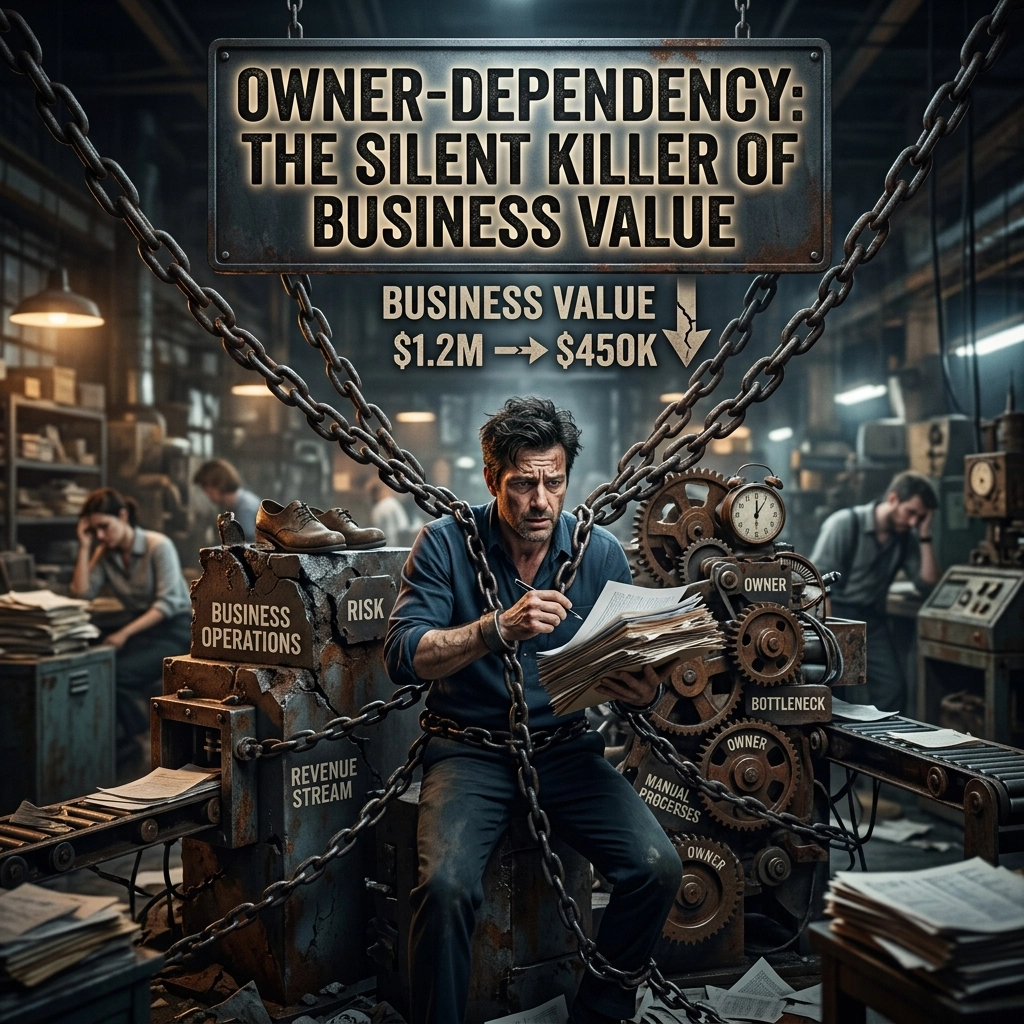
Most property management owners believe they are building a fortress of recurring revenue. You spend years grinding, managing difficult tenants, and courting property owners to grow your door count. But if every major decision, every high-level client relationship, and every operational fire requires your direct intervention, you haven't built an asset. You’ve built a cage that requires your presence to function.
When it comes time for selling a property management business, this "hub-and-spoke" model: where you are the hub and every process is a spoke: is a silent killer of value. Buyers are not looking to buy your job; they are looking to buy a self-sustaining cash flow. If the business can't breathe without you, the valuation will suffer a massive hit.
1. The Real Cost of Being Indispensable
A business that relies on its owner for survival is viewed as a high-risk investment by professional buyers. Research shows that owner-dependent businesses often see valuations 30% to 50% lower than their systematized counterparts. While a well-oiled machine might command a high multiple of EBITDA, an owner-centric shop might struggle to find a buyer at all, or face heavy discounts. Buyers see your personal involvement as a single point of failure that could lead to immediate churn after the sale.
2. The Buyer’s Perspective on Risk
When a buyer evaluates your property management company, they are looking for stability and transferability. They ask a simple but devastating question: "What happens to this revenue when the owner leaves?" If the answer is that the top 20% of your property owners will leave because they only have a relationship with you, your business's value is effectively halved. To get a high business valuation, you must prove that the business thrives regardless of who sits in the owner’s chair.

3. The Multiplier Effect of Systematization
Systematized businesses command higher multiples because they offer a predictable outcome. Buyers, especially institutional ones and private equity groups, are willing to pay a premium for "turnkey" operations. When you have documented processes for everything from tenant screening to move-out inspections, you reduce the operational risk for the new owner. This reliability allows them to focus on growth rather than day-to-day survival, which justifies a higher price tag.
4. Transitioning Your Client Relationships
Direct relationships between the owner and the property owners are the most common form of value-killing dependency. If you are the only one who handles renewals or discusses portfolio performance with your biggest clients, those accounts are not transferable. You need to introduce account managers or lead property managers as the primary point of contact months or even years before a sale. This ensures the rent roll value remains steady when the deed of sale is signed.
5. Documenting the "How" Through SOPs
Standard Operating Procedures (SOPs) are the manual for your business that allow it to run without your constant supervision. Every recurring task in your office should have a written or video-based guide that any competent employee can follow. This includes maintenance coordination, owner disbursements, and marketing for new doors. Buyers look for these manuals during due diligence to confirm that the team knows how to execute without your guidance.

6. Empowering Your Middle Management
A business is only as strong as the team that remains after the owner exits. If you are making every decision about whether to waive a late fee or which vendor to hire for a roof repair, your team’s growth is stunted. You must delegate authority, not just tasks, to your staff. Buyers want to see a management layer that is capable of problem-solving independently, as this represents a "clean" and scalable acquisition.
7. The Dangers of the "Owner-Salesman" Trap
If you are the only person capable of bringing in new doors, your business lacks a sustainable growth engine. Many owners feel stuck at 500 doors because they are the sole source of sales, creating a bottleneck for expansion. Fixing your sales system involves creating a lead generation and conversion process that functions without your charisma. A buyer will pay more for a business that has a proven, automated way to acquire new property owners.
8. The Financial Impact of Deal Structure
Owner-dependency doesn't just lower the price; it ruins the deal terms. If a buyer perceives the business is too dependent on you, they will likely demand a large "earn-out" or a significant holdback of the purchase price. This means you might only see 60% of your money at closing, with the rest contingent on you staying on for years or the business hitting specific targets. Reducing dependency allows for more cash at closing and a faster exit.

9. Identifying Your Internal Bottlenecks
You cannot fix what you haven't identified, so you must audit your daily activities to find where you are the bottleneck. Track your time for two weeks and note every time an employee or client asks for your approval or input. These are the points where the business is stuck on you. Each of these interruptions represents a process that needs to be delegated or a system that needs to be built.
10. The Vacation Test
The ultimate test of owner-dependency is your ability to leave the business for three weeks without checking email. If the business grows, or at least remains stable, while you are gone, you have a valuable asset that is ready for the market. If you return to a mountain of problems and angry clients, you still have work to do before selling your property management company. Most buyers will perform their own version of this test during their transition period.
11. Technology as a Bridge to Independence
Leveraging property management software can automate the workflows that previously required your oversight. Modern platforms handle everything from automated rent collection to maintenance requests and owner portals. By centralizing all communication and data in a system rather than your head, you make the business "portable." A buyer can step into a software-driven environment much easier than one driven by an owner's personal memory and intuition.
12. Preparing for the Final Hand-Off
The goal of detaching from your business is to make yourself the least important person in the room. When you reach the point where the business runs smoothly, generates profit, and grows without your daily input, you have maximized your valuation. At this stage, you aren't just selling a job; you are selling a high-performing investment. This shift in perspective is what separates average sales from record-breaking exits in the property management industry.

13. Why Consistency Matters During the Exit
Buyers value a steady hand and a clear trajectory above all else. If the business's performance fluctuates based on your personal energy levels, it signals instability. Maintaining solid growth through a delegated team shows that the business has its own momentum. This momentum is exactly what buyers are looking for when they look for what they really want in a PM business.
Detaching for Success
Detaching yourself from the daily operations of your property management company is not just about reducing stress; it is a strategic financial move. Every task you successfully delegate and every process you document adds direct value to your eventual sale price.
When you move from being the operator to the owner, you transform your company into an attractive target for high-quality buyers. This process takes time, but the reward is a cleaner exit, a higher multiple, and the freedom to walk away on your own terms.
If you are curious about how your current level of involvement might be affecting your company's market value, we invite you to explore a confidential conversation. Understanding your current standing is the first step toward a successful transition. For a discreet evaluation of your business and its readiness for the market, you can reach out to us at PM Business Broker. Our team focuses on helping you navigate the complexities of selling a property management business with privacy and professional guidance.

