

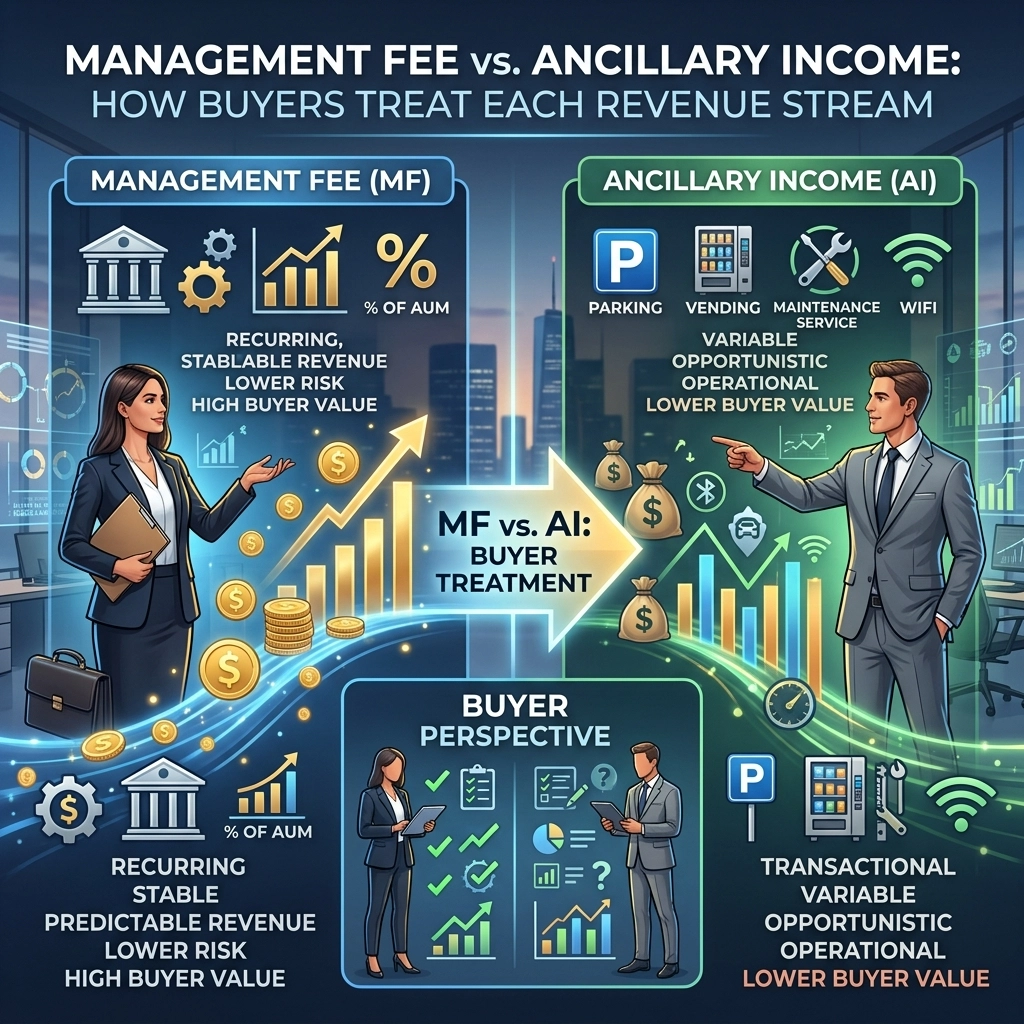
When you look at your Profit and Loss statement, every dollar looks the same. To a buyer looking to acquire your property management company, those dollars are weighted very differently. A dollar earned from a monthly management fee is fundamentally more valuable than a dollar earned from a one-time maintenance markup or a late fee.
Understanding this distinction is critical for any owner planning an exit. If you do not categorize your revenue correctly, you risk miscalculating your company's worth and entering negotiations with a skewed perspective. Professional buyers use a specific lens when performing a rent roll valuation, and their focus is on the sustainability and predictability of your cash flow.
1. The Core of Rent Roll Valuation
The rent roll is the heartbeat of your property management business. When an advisor or buyer evaluates your portfolio, they are looking for "contractual recurring revenue." This is the income that is guaranteed to hit the bank account every month as long as the property remains under management.
In the world of M&A, the primary driver of value is the recurring management fee. This is usually a percentage of the gross rent collected: typically ranging from 3% to 12% depending on the property type and market. Buyers prize this revenue because it requires the least amount of "variable effort" to maintain once the account is onboarded. It provides a steady, predictable baseline that allows a new owner to forecast their Return on Investment (ROI) with high confidence.

2. Why Management Fees Command the Highest Multiples
A buyer will typically apply a higher multiple to your recurring management fees than to any other income stream. If a business is being sold on a revenue multiple: often between 1.0x and 1.5x of annual management fees: the ancillary income is frequently either discounted or excluded from the primary calculation.
Management fees are considered "sticky." Property owners rarely fire a management company for no reason, making this income stream highly resilient. Because these fees are tied directly to the lease and the management agreement, they represent the most stable asset you own. When you start fixing your sales system, focusing on growing this specific revenue line will have the most significant impact on your final sale price.
3. The Nature of One-Time Leasing and Placement Fees
Leasing fees, tenant placement fees, and lease renewal fees are essential for cash flow, but they are viewed as "volatile" by buyers. These fees depend entirely on tenant turnover. If you have a year with very low turnover, your leasing fee revenue will plummet.
A buyer cannot guarantee that turnover rates will remain high or consistent. In fact, many buyers view high turnover as a negative indicator of portfolio health. Consequently, they may apply a much lower multiple to this income: sometimes as low as 0.5x: or they may average the last three years of leasing fees to find a "normalized" figure. When you are preparing your company for a sale, you must be prepared to defend the consistency of these fees.
4. Maintenance Surcharges and In-House Services
If your company has an in-house maintenance division or charges a markup on vendor invoices, you are generating significant ancillary income. While this adds to your bottom line, it also adds complexity and risk. Maintenance revenue requires staff, vehicles, insurance, and equipment.
Buyers categorize this as "high-effort revenue." It is not passive or semi-passive like a management fee. If a buyer does not intend to keep your maintenance staff or if they plan to outsource repairs, they may place zero value on this revenue stream during the valuation process. They are buying the rent roll, not necessarily a construction or repair business. To ensure you get credit for this income, you must demonstrate that the maintenance profit margins are consistent and that the operation is systematized.

5. The Rise of Resident Benefit Packages (RBP)
In recent years, Resident Benefit Packages have become a massive driver of ancillary income. These packages often include renters insurance, HVAC filter delivery, and credit building services. Because these fees are charged monthly per door, they behave much more like a recurring management fee than a one-time leasing fee.
Sophisticated buyers are beginning to treat RBP income with more respect in valuations. If you can show that 90% of your doors are enrolled in a mandatory RBP, a buyer may include that revenue in the core valuation. This is a high-margin stream that utilizes existing infrastructure with minimal overhead. It is one of the reasons buyers love PM businesses right now.
6. Late Fees, Admin Fees, and "Junk" Revenue
Fees such as late payment penalties, NSF fees, and application fees are often classified as "ancillary" or even "incidental" income. While these contribute to your EBITDA, they are rarely given a multiple in a revenue-based valuation.
Buyers often view high late fee revenue as a red flag. It suggests that the tenant base is unstable or that your collection processes are weak. Professional buyers want to see a clean portfolio with high-quality tenants. If a significant portion of your profit comes from penalizing tenants, a buyer will likely discount that income entirely, fearing that improved management will actually decrease that specific revenue line.
7. How to Weight Your Income for Maximum Value
To get the best price for your business, you should aim for a "clean" revenue split. Buyers prefer to see at least 70% to 80% of total revenue coming from recurring management fees. If your ancillary income represents more than 30% of your total revenue, you need to be able to explain why that income is sustainable and how it doesn't create excessive operational drag.
When you evaluate what buyers really look for, you will find they prioritize "low-touch" profitability. If your ancillary income requires heavy manual labor, it will be valued lower. If it is automated (like an RBP or a technology fee), it will be valued higher.

8. The Impact of Portfolio Composition on Multiples
The type of properties you manage also dictates how buyers treat your revenue. A portfolio of single-family homes typically generates higher management fees per unit but has higher per-unit operational costs. Conversely, a large multi-family complex may have lower percentage-based fees but much higher ancillary potential through laundry, parking, and utility bill-backs.
During a rent roll valuation, a buyer will look at the average revenue per unit (ARPU). They want to see a healthy mix. If your management fees are too low, they will worry about your margins. If they are too high, they will worry about "fee fatigue" and client churn. Striking a balance is the key to breaking through the 500–1,000 door ceiling.
9. Preparing Your Financials for Due Diligence
The biggest mistake you can make is "co-mingling" these revenue streams in your accounting software. When a buyer performs due diligence, they will ask for a detailed breakdown of your income. If your "Management Fee Income" account includes leasing fees and late fees, the buyer will have to manually deconstruct your financials.
This creates doubt. Doubt leads to lower offers. Ensure your Chart of Accounts clearly separates:
- Recurring Management Fees
- Leasing/Placement Fees
- Maintenance Income (Gross)
- Maintenance Expenses (COGS)
- Ancillary Tenant Fees (RBP, Late Fees)
- Ancillary Owner Fees (Annual Inspections, 1099 Fees)
Clear financials allow a buyer to see the "quality" of your earnings immediately, which often leads to a smoother transaction and a higher multiple.
10. Strategizing Your Exit
If you are planning to sell within the next 12 to 24 months, your focus should be on converting variable income into recurring income where possible. For example, if you currently charge for inspections on an ad-hoc basis, consider rolling that into a slightly higher monthly management fee or a recurring "compliance fee."
Buyers pay for certainty. The more you can prove that your income will show up next month without you having to "sell" a new service or wait for a tenant to move out, the more valuable your company becomes. If you are unsure where your current valuation stands, exploring a business valuation now can give you a roadmap for the changes you need to make.

Summary of Revenue Treatment
In the eyes of an M&A advisor:
- Management Fees: The "Gold Standard." Valued at the highest multiple.
- Ancillary Recurring (RBP): High Value. Often included in the core valuation if adoption is high.
- Leasing/Renewal Fees: Moderate Value. Usually averaged and discounted.
- Maintenance Markup: Variable Value. Depends on the buyer’s operational model.
- Late Fees/Fines: Low Value. Usually excluded from the revenue multiple but included in EBITDA.
By aligning your business model with how buyers perceive value, you ensure that you aren't just building a profitable company, but a highly sellable asset. If you are ready to discuss the specifics of your portfolio in a private setting, we are here to help you navigate the complexities of the market.
For a confidential exploration of your company's market value, contact PM Business Broker today. We prioritize discretion and industry-specific expertise to ensure you receive the most accurate assessment of your life's work.

