

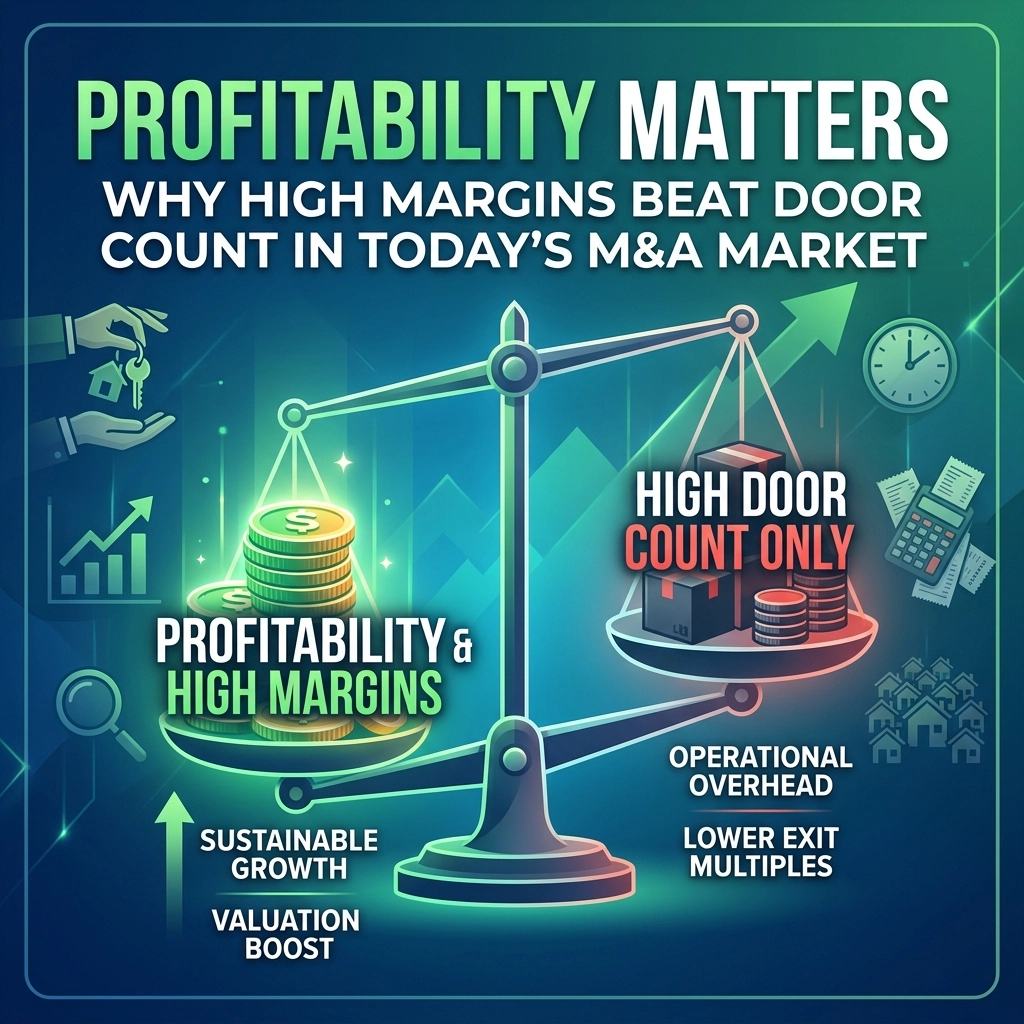
For years, the property management industry has used door count as the ultimate measuring stick. You see it at every conference and industry meetup. Owners introduce themselves not by their service quality or their take-home pay, but by the number of units they manage.
The common belief is that a 1,000-door company is inherently more valuable than a 500-door company. In the world of Mergers and Acquisitions (M&A), this assumption is often dangerously incorrect. In the current market, sophisticated buyers are looking past the "vanity metrics" to see what is actually happening at the bottom of your profit and loss statement.
High margins beat door count every single time because a buyer is not purchasing your workload. They are purchasing your future cash flow and the efficiency of your operating system. If your business is built on high volume but razor-thin margins, you are selling a job, not a high-value asset.
1. Understanding the Vanity Metric Trap
Door count is a measure of activity, not a measure of success. You can add 200 doors in a year and actually be in a worse financial position than when you started. If those doors are low-fee accounts with high-maintenance tenants and demanding owners, they drain your resources.
A high door count often masks operational inefficiencies. When you focus solely on growth by unit count, you tend to ignore the cost of acquisition and the cost of service. This leads to a "bloated" business that looks impressive on paper but struggles to generate significant free cash flow.
In a sale, a buyer will look at your rent roll value and quickly realize if the doors you have are actually profitable. They aren't interested in the stress of managing 1,000 doors if a 500-door portfolio produces the same net profit.
2. Why Profit Margins Drive Valuation Multiples
Business valuations in the property management space are typically based on a multiple of EBITDA (Earnings Before Interest, Taxes, Depreciation, and Amortization). While the multiple is applied to the profit, the quality of your margins determines what that multiple will be.
A company with a 30% profit margin is seen as a well-oiled machine. It suggests that you have a disciplined sales process and a lean operational structure. Buyers are willing to pay a higher multiple for these businesses because the risk of "breakage" during the transition is lower.
Conversely, a company with a 10% margin is viewed as high-risk. Any slight increase in labor costs or a small dip in revenue could push the business into the red. Buyers will lower their offer or walk away entirely from low-margin operations, regardless of the door count.

3. The Efficiency Premium in Today’s Market
Modern buyers, especially strategic acquirers and private equity groups, value efficiency over raw scale. They are looking for "platform" businesses that can absorb more doors without a linear increase in overhead. A high-margin business proves that your systems are scalable.
When you have high margins, it shows you have mastered the sales system. You aren't just taking any client who calls; you are selecting clients that fit your model. This discipline is exactly what buyers really look for in a property management business.
Efficiency also translates to better employee retention. High-margin businesses can afford better talent and better technology. A buyer knows that a stabilized, happy team is much easier to manage post-acquisition than a team that is overworked and underpaid in a low-margin environment.
4. Risk Mitigation and Portfolio Health
A high-margin portfolio is generally a "cleaner" portfolio. Higher margins often come from higher average management fees and a healthy mix of ancillary income. This usually means you are managing higher-quality properties for more reasonable owners.
Low-margin businesses often suffer from "revenue churn." This happens when you have to constantly add new doors just to replace the ones you are losing because your service quality is suffering from thin margins. Buyers view this constant churn as a major red flag during due diligence.
If you want to understand why buyers pay more for some property management businesses than others, look at the stability of the revenue. A high-margin business is resilient. It can withstand market fluctuations and localized economic downturns much better than a business barely breaking even.
5. The Role of Ancillary Revenue in Boosting Margins
One of the quickest ways to separate yourself from the "door count" crowd is through ancillary revenue streams. These include resident benefit packages, technology fees, and lease renewal fees. These lines of revenue often have very high margins because they require little additional labor to execute.
Sophisticated buyers love ancillary revenue. It diversifies the income stream and makes the business less dependent on the base management fee. When you maximize these revenue streams, your profit-per-door increases significantly.
By focusing on profit-per-door rather than total doors, you create a more attractive target for acquisition. You demonstrate that you understand how to extract maximum value from your existing infrastructure. This is a key part of how property management companies grow without adding chaos.

6. The 500 vs. 1,000 Door Comparison
Let's look at a practical example. Business A has 1,000 doors, generates $1.5M in revenue, but only has a 10% profit margin ($150k EBITDA). Business B has 500 doors, generates $900k in revenue, and has a 30% profit margin ($270k EBITDA).
Even though Business A is twice the size in terms of door count, Business B is significantly more valuable. Business B generates nearly double the actual profit. Furthermore, a buyer will likely apply a higher multiple to Business B because the operations are clearly more efficient.
Business A is a liability in disguise. It requires a large staff, more office space, and more complex management systems for less financial reward. Business B is an asset. It provides a steady, high-margin return with half the operational headache.
7. Preparing Your Business for a High-Value Exit
If you are currently sitting on a large door count with low margins, you have work to do before you list your business. You need to focus on "trimming the fat." This might mean firing your most difficult, least profitable clients.
It sounds counterintuitive to reduce your door count to increase your value, but in the M&A world, it works. Removing 50 low-value doors that take up 20% of your staff's time can actually improve your bottom line. It allows your team to focus on providing better service to high-value clients, reducing churn and increasing the opportunity for ancillary revenue.
As you prepare your property management company for a sale, your goal should be to maximize your EBITDA margin. Buyers will scrutinize your last 24 months of financials. Showing a steady trend of increasing margins is the best way to drive up your asking price.
8. What Buyers Look for During Due Diligence
During due diligence, the buyer isn't just counting contracts. They are looking at your "unit economics." They want to see exactly how much it costs you to manage a single door versus how much revenue that door generates.
They will analyze your labor-to-revenue ratio. In a healthy, high-margin business, labor costs usually stay below 40-50% of gross revenue. If your labor costs are creeping toward 60% or 70%, it signals that your door count has outpaced your efficiency.
Clean financials are non-negotiable. If you cannot clearly show where your profit is coming from, a buyer will assume the worst. For more insights on this process, you should review what owners should know before listing.

9. The Strategic Buyer's Perspective
Strategic buyers: those who already own a property management company and are looking to expand: care about margins because they want to know what the "pro-forma" profit will look like after they integrate your business.
If your margins are high, it tells them that your current pricing is sustainable and that your clients value your service. They can fold your portfolio into their existing operations and maintain that profitability. If your margins are low, they have to worry about raising fees on your clients after the sale, which leads to high churn and a lower return on their investment.
Strategic buyers are often willing to pay a premium for a high-margin portfolio that fits seamlessly into their geographic footprint. They aren't just buying doors; they are buying a successful business model.
10. Moving Toward a Profit-First Mindset
If you want to break through the common plateau of 500 to 1,000 doors, you must stop obsessing over the number of units. Shift your focus to the net profit margin. Ask yourself: "How can I make more money with the doors I already have?"
This mindset change often leads to better technology adoption, better fee structures, and a more professional team. It moves you from being a "collector of doors" to a "manager of a high-value asset."
Ultimately, your exit strategy depends on this shift. Whether you are planning your exit now or five years from now, the market will reward your profitability, not your size.
Summary of Values
In the modern M&A landscape, the "bigger is better" mantra is dead. Sophisticated buyers have realized that door count is a poor indicator of business health. They are looking for high margins, operational efficiency, and sustainable cash flow.
If you are looking to maximize the value of your property management business, focus on the following:
- Maximize average revenue per unit (ARPU) through ancillary services.
- Maintain a disciplined labor-to-revenue ratio.
- Fire low-value, high-maintenance accounts that drain resources.
- Invest in systems that allow you to scale without adding significant overhead.
When you focus on the bottom line, the top line becomes much more meaningful. A high-margin business is not only easier to run today, but it is also much easier to sell tomorrow.
If you are curious about the current value of your portfolio or want to explore what a transition might look like for your business, we are here to help. At PM Business Broker, we specialize in navigating the complexities of the property management market.
All conversations are handled with the utmost discretion and privacy. Whether you are ready to sell or just starting to explore your options, we can provide the clarity you need to make an informed decision. For more information on the industry, you can also explore resources at Vision Fox or Sell My PM Biz.

