

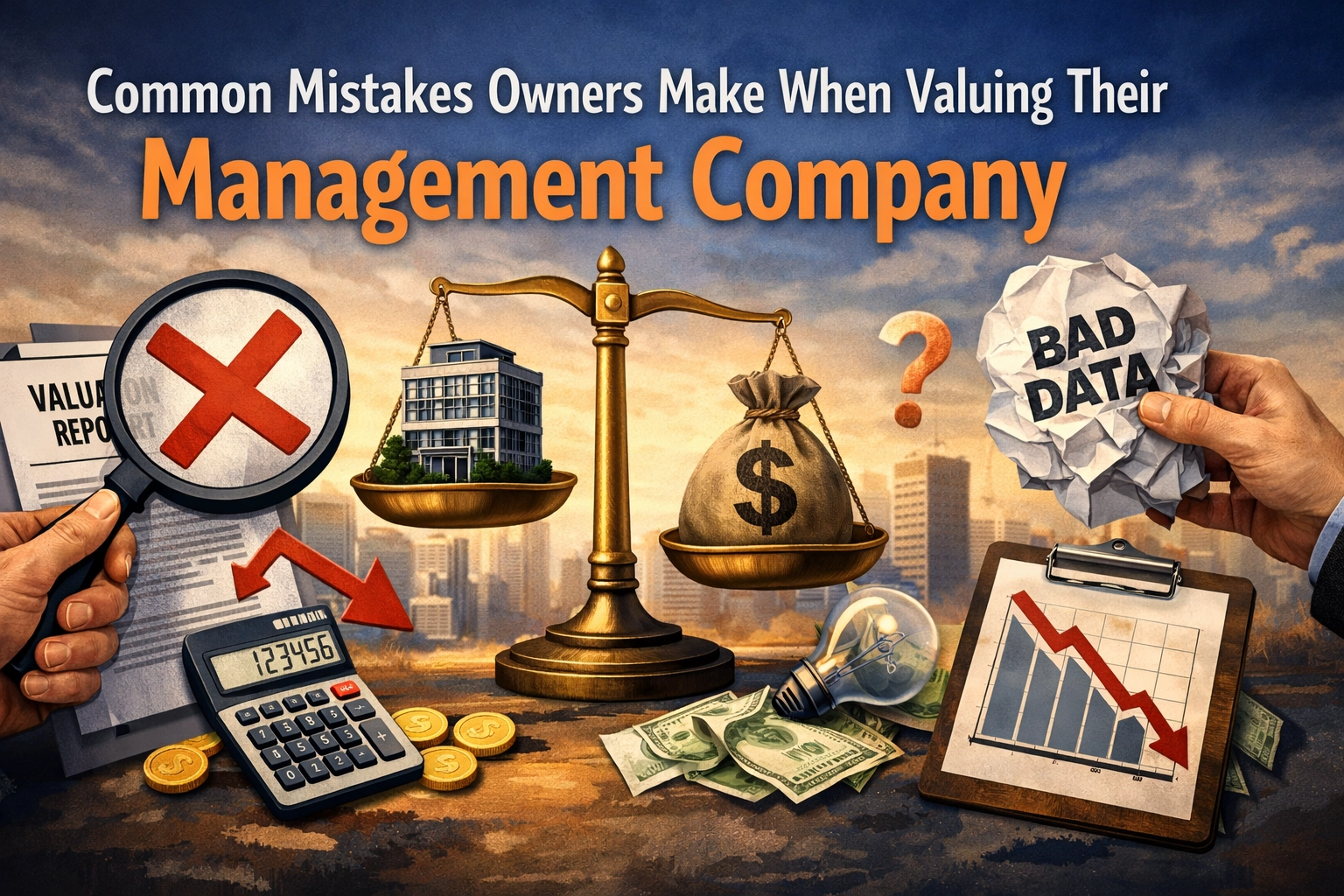
Determining the value of your property management company is a pivotal moment in your career. Whether you are planning an immediate exit or looking five years down the road, an accurate valuation provides the clarity you need to make informed decisions. However, many owners approach this process with assumptions that do not align with how buyers or lenders actually view a business. Miscalculating your worth can lead to a stalled sale or, worse, leaving significant money on the table.
Understanding the logic of the market is the first step toward a successful transition. This guide explores the common errors owners make during the business valuation process and offers a steady path toward a more realistic assessment.
1. Overestimating the "Price Per Door" Metric
The most frequent mistake in the industry is relying too heavily on a flat "price per door" figure. While this metric is a common shorthand in casual conversations, it rarely reflects the actual complexity of a business. A door is not a standardized unit of value; it is a contract that produces a specific amount of net income.
If you value every door at $2,500 but your average management fee is low or your overhead is high, that number is misleading. Buyers do not buy doors; they buy the recurring cash flow those doors generate. Overestimating this value often happens when owners ignore the specific profitability of each account in their portfolio.
2. Ignoring Churn Rates and Client Concentration
A management company with 500 doors and a 20% annual churn rate is a different asset than a company with 500 doors and a 5% churn rate. Many owners fail to factor in the cost of replacement when valuing their firm. If you are constantly losing clients and spending heavily to acquire new ones, your business is less stable than a "steady state" operation.

Client concentration is another factor that owners often overlook. If 30% of your doors belong to a single developer or investor, your business carries a higher risk profile. A buyer will likely discount the valuation because the loss of that one relationship could cripple the company’s bottom line. High churn and high concentration are red flags that decrease the multiple a buyer is willing to pay.
3. Focusing on Revenue Instead of Seller’s Discretionary Earnings (SDE)
It is common to hear owners brag about their gross revenue. While top-line growth is important, valuation is primarily driven by Seller’s Discretionary Earnings (SDE). This figure represents the total financial benefit an owner-operator derives from the business, including net profit, the owner’s salary, and legitimate add-backs like non-recurring expenses.
Many owners make the mistake of failing to "clean" their books before a valuation. They may have personal expenses mixed with business costs or fail to account for the market-rate salary a replacement manager would require. If your SDE is not clearly documented and defensible, a buyer will assume the worst and lower their offer. You can learn more about how to refine your financial presentation in our guide on the top 5 steps to prepare your property management company for a sale.
4. Overlooking Portfolio Quality and Class
Not all properties are created equal in the eyes of an acquirer. An owner might value a portfolio of 200 doors in a high-crime area the same as 200 doors in a premium suburban neighborhood. This is a logical error. C-class and D-class properties often require more intensive labor, have higher delinquency rates, and experience more frequent maintenance issues.
Buyers generally prefer A-class and B-class portfolios because they offer "cleaner" revenue with lower operational friction. If your portfolio is labor-intensive, your valuation should reflect the higher cost of management. Ignoring the class of your doors leads to an inflated sense of value that will not survive the due diligence process.
5. Relying on a Single Valuation Method
Valuing a business is not a one-dimensional task. Owners often pick the method that gives them the highest number: usually a market multiple: and ignore other perspectives. A professional valuation considers the income approach, the market approach, and sometimes the asset-based approach.

By using only one method, you miss the nuance of your specific market conditions. For example, why buyers love PM businesses right now often relates to the stability of recurring income, but that doesn't mean every company qualifies for a top-tier multiple. Using multiple methods provides a "range of value" that is much more defensible during negotiations.
6. Miscalculating Add-Backs and Discretionary Expenses
The "add-back" process is where many valuations go off the rails. Owners sometimes try to add back expenses that are actually necessary for the operation of the business. For instance, if you spent $10,000 on a one-time software upgrade, that is a legitimate add-back. However, if you try to add back a recurring marketing expense because "the new owner might not need it," you are on shaky ground.
Logic dictates that a buyer will only accept add-backs that are truly non-recurring or personal in nature. If you overreach here, you lose credibility. A clean, honest SDE calculation is always more valuable than an inflated one that falls apart under scrutiny.
7. Neglecting the Value of Systems and Staff
A property management company that depends entirely on the owner to function is worth less than one with a solid management team and documented systems. Owners often mistake their own "sweat equity" for business value. If the business cannot run for a month without your direct involvement, it is not an investment; it is a job.

Buyers pay a premium for "turnkey" operations. If your processes are stored in your head rather than a manual or a software system, your valuation will suffer. When valuing your company, look objectively at how much of the "value" is tied to your personal relationships and daily presence. If that percentage is high, you may be seeing signs it might be time to sell while you can still institutionalize that knowledge.
8. Underestimating the Impact of Ancillary Revenue
In modern property management, revenue isn't just about management fees. Leasing fees, maintenance markups, technology fees, and HVAC filter programs all contribute to the bottom line. Some owners fail to track these accurately, leading to an undervalued business.
Conversely, some owners overestimate the sustainability of these fees. If your maintenance department is highly profitable but relies on one specific technician who plans to leave when you do, that revenue is at risk. A logical valuation looks at the diversity and stability of all income streams, not just the base management fee.
9. Ignoring Current Market and Economic Trends
Valuation does not happen in a vacuum. Interest rates, local rental market health, and even national legislation regarding tenant rights all impact what a buyer is willing to pay. Owners often look at what a friend’s company sold for three years ago and assume the same multiple applies today.
The market for M&A in property management is dynamic. Factors like the "cost of capital" for buyers play a huge role in the multiples they can afford. If you ignore the broader economic environment, you will likely set an unrealistic expectation that prevents your business from ever reaching the closing table.
10. Emotional Attachment and "Sweat Equity"
It is difficult to remain objective about a business you built from the ground up. Many owners feel that the years of late-night calls and stressful evictions should be "priced in." Unfortunately, the market does not pay for past effort; it pays for future earnings.
Emotional pricing is the fastest way to kill a deal. A buyer cares about the future risk and the future reward. They do not care how hard you worked ten years ago. Approaching your valuation with a matter-of-fact, logical mindset allows you to see your company through the eyes of an investor, which is exactly who your buyer will be.
Moving Toward an Accurate Valuation
The goal of a valuation is not to find the biggest number possible, but the most accurate one. An accurate number allows you to plan your future with confidence. It ensures that when you do decide to go to market, the process is smooth, the due diligence is boring, and the closing is certain.
If you are unsure where your company stands, the most logical step is to seek a professional assessment. Avoiding these common mistakes will put you ahead of the majority of owners and ensure that your hard work is rewarded with a fair and successful exit.
At PM Business Broker, we focus on providing clear, understated guidance to help you navigate these complexities. If you are ready to explore the true value of your firm with discretion and privacy, we are here to help you begin that journey. Understanding your current standing is the only way to reach your ultimate destination.

