

When you look at your property management company, you likely see a collection of hard-earned relationships and steady monthly revenue. You see the years spent building trust with local landlords and the systems you created to keep their properties profitable. However, when a professional buyer looks at your business, they see something very different: they see a risk profile.
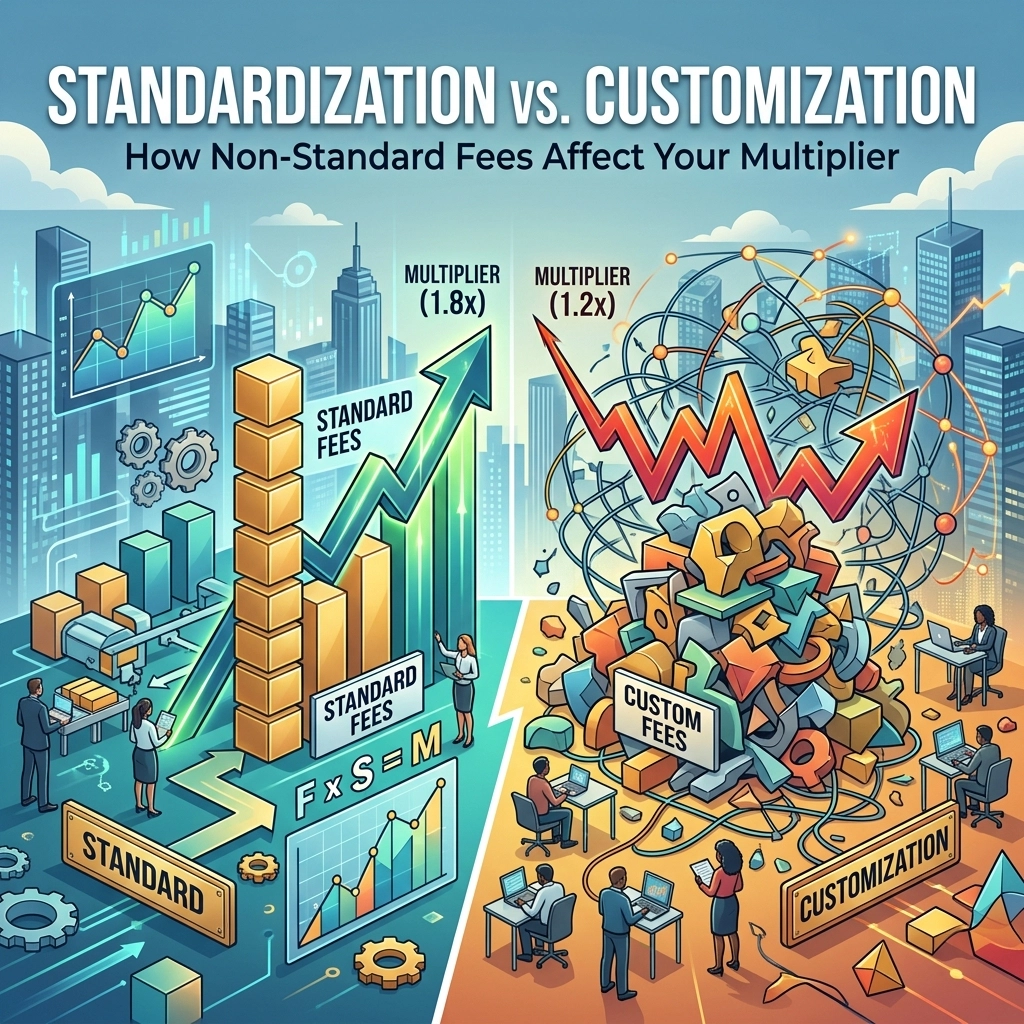
In the world of property management M&A, the "multiplier" is the number that dictates your final exit price. While many owners focus on the total number of doors, the multiplier is often determined by the quality and consistency of your management agreements. If your contracts are a patchwork of custom deals and "grandfathered" fee structures, you are likely leaving significant money on the table.
Standardization is not just an administrative preference; it is a fundamental pillar of business value. Understanding how non-standard fees erode your valuation is the first step toward preparing for a high-value exit.
1. Buyers value scalability above all else
Institutional buyers and aggressive local competitors are looking for a business they can easily integrate into their existing operations. They want to be able to apply their own software, staffing models, and accounting processes to your portfolio without a manual workaround for every third client. When your fees are standardized, your business is a "plug-and-play" asset that commands a premium.
Customized fee structures act as sand in the gears of a larger machine. If a buyer has to manually adjust invoices or remember that "Owner X" doesn't pay a lease-renewal fee, it creates a labor-intensive environment. This lack of scalability forces the buyer to lower the multiplier because the cost to manage your portfolio is higher than a standardized one.

2. Custom contracts represent "Contractual Debt"
Every time you agree to a one-off management fee or waive a standard charge to win a deal, you are creating contractual debt. This debt doesn't show up on your balance sheet as a liability, but it appears during business valuation. Buyers view these custom agreements as problems they will eventually have to fix, usually at the risk of losing the client.
A buyer will look at your "effective" management fee versus your "contracted" management fee. If there is a wide gap because of various discounts you’ve handed out over the years, the buyer will assume that revenue is unstable. They will often apply a lower multiplier to that specific portion of your revenue or discount the entire business to account for the work required to standardize those contracts post-closing.
3. Complexity increases due diligence friction
The due diligence process is where deals go to die or where the price gets "re-traded" (lowered). If a buyer's audit reveals that you have twelve different versions of a management agreement, the process slows to a crawl. The buyer’s legal and financial teams must vet each variation to ensure there are no hidden liabilities or terms that could blow up the deal.
Friction in due diligence creates doubt, and doubt leads to a lower multiplier. A clean, standardized set of contracts allows the buyer to move quickly and gives them confidence that they are buying exactly what you advertised. You can learn more about what buyers really look for to see why clarity is such a vital asset during a sale.

4. Ancillary fees are the lifeblood of high multipliers
Modern property management valuation is no longer just about the base management fee. Buyers are increasingly focused on ancillary income: leasing fees, renewal fees, late fees, and maintenance markups. If your portfolio is customized, these ancillary fees are often the first thing that owners negotiate away.
A business where every door generates a full suite of ancillary fees is worth significantly more than a business where 30% of the owners have "opted out" of those charges. Buyers apply a much higher multiplier to diversified, standardized revenue streams. If your revenue is "clean" across the board, your valuation reflects that stability and growth potential.
5. Non-standard fees create a "Post-Closing Churn" risk
Buyers are deathly afraid of "churn": the loss of clients immediately after a sale. If a significant portion of your portfolio is on "sweetheart deals" or custom rates, the buyer knows they will have to eventually bring those clients up to market rates. This transition is a prime opportunity for those owners to leave and find another manager.
Because of this risk, buyers will often segment your portfolio into "standard" and "non-standard" buckets. They may offer you a 4x multiple on standard revenue and only a 2x or 3x multiple on the custom accounts. In some cases, they may exclude the custom accounts from the valuation entirely if the fees are too low to be profitable under the buyer's cost structure.

6. The "Friend and Family" trap
Many property management owners started by managing properties for friends, family, or early "legacy" clients at a steep discount. Over time, these accounts become a burden that provides very little profit but requires the same amount of effort as a full-fee account. While you may feel a personal obligation to keep these rates low, a buyer does not.
When you prepare for a sale, these low-value accounts can actually drag down your overall multiplier. They inflate your door count without contributing proportionally to your bottom line. If you are struggling with these types of accounts, it may be time to fix your sales system and standardize your pricing before you approach the market.
7. How to begin the standardization process
If you realize your portfolio is a patchwork of custom deals, don't panic. You can start the standardization process today to improve your multiplier before you list the business. Begin by identifying all contracts that are more than 10% below your current standard rate and create a plan to bring them in line over the next 12 to 18 months.
Send out updated management agreements that reflect your current service levels and fees. Most owners understand that costs increase over time and will accept a reasonable adjustment. Those who don't may not be the type of clients a buyer wants to acquire anyway. By cleaning up the "hair" on your portfolio, you make the business far more attractive to professional M&A advisors and buyers.

8. The psychological impact on the buyer
There is a psychological element to business valuation that many sellers overlook. A business with standardized fees and contracts looks professional, disciplined, and well-managed. It signals to the buyer that you have been in control of your business rather than letting your clients dictate how you operate.
A "clean" business allows the buyer to focus on growth and synergy rather than cleanup and repair. When a buyer feels they are walking into a tight ship, they are more likely to offer a top-of-market multiplier. You can see how this fits into the broader picture by reviewing the top 5 steps to prepare for a sale.
Why standardization pays off at closing
In the property management industry, your contracts are the product. If your product is inconsistent and customized for every buyer, it is difficult to value and even more difficult to sell. By moving toward a standardized model, you are not just making your daily life easier; you are actively building equity in your business.
A property management company with a 10% management fee and a full suite of standard ancillary fees across 100% of the portfolio will always out-value a larger, "messy" company with a higher door count but inconsistent fees. In the end, the multiplier is a measure of trust. The more standardized your business, the more a buyer can trust that the revenue they see today will still be there tomorrow.
If you are curious about how your current fee structure might be affecting your specific company's value, we can help. At PM Business Broker, we specialize in analyzing these nuances to help owners maximize their exit. Whether you are ready to sell now or are just starting to plan your transition, understanding your numbers is the first step.
Every business has some level of customization, but the goal is to minimize its impact before you hit the market. A focused effort on standardization can be the difference between a mediocre offer and a life-changing exit. If you’d like to explore what your business might be worth in today’s market, you can reach out to us for a private consultation. We maintain strict discretion and can help you identify the specific "valuation leeches" that might be holding your multiplier back.

