

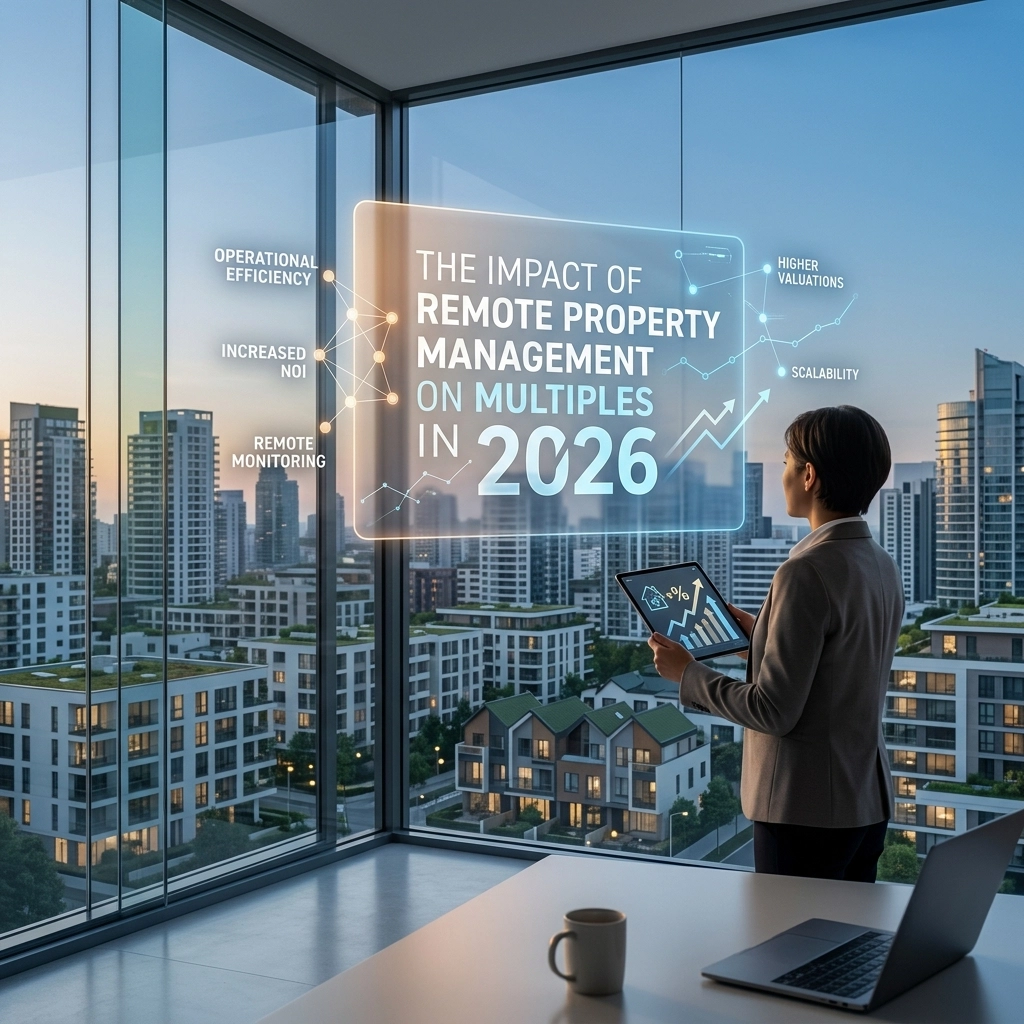
The landscape of property management has shifted permanently as we move through 2026. The days of a central office filled with local property managers, leasing agents, and admin staff are largely behind us. Today, the most profitable companies operate with distributed teams and virtual systems. This transition is not just a change in operations; it is a fundamental shift in how these businesses are valued.
For years, valuation was a simple calculation of your door count and a standard multiple of your Seller’s Discretionary Earnings (SDE). However, the rise of remote staffing and virtual management has introduced new variables into the business valuation equation. Buyers are no longer just looking at the bottom line. They are looking at the efficiency of the engine that produces it.
1. The Dramatic Reduction in Fixed Overhead
The most immediate impact of remote management is the collapse of traditional overhead costs. In 2026, a lean property management firm rarely carries the burden of a large commercial lease or heavy utility bills. You have traded expensive square footage for digital infrastructure and cloud-based management tools.
This reduction in fixed costs flows directly to your EBITDA. When a buyer looks at your P&L, they see a much healthier margin compared to the "heavy" firms of the past. These higher margins often lead to higher multiples because the business is viewed as more resilient and less exposed to local real estate market fluctuations.
2. Global Talent and Labor Arbitrage
Remote staffing has allowed property management owners to tap into global talent pools. You are no longer limited to the hiring pool within a twenty-mile radius of your office. By utilizing virtual assistants and offshore specialized roles, you have significantly lowered your effective hourly rate for administrative and back-office tasks.
Buyers value this because it proves the business can scale without a linear increase in payroll costs. If you can manage 1,000 doors with the same core leadership team and a scalable remote support staff, your business becomes a highly attractive acquisition target. This efficiency is a primary driver behind the rising multiples we are seeing in the current PM acquisition market.

3. The Necessity of Robust Systems and Documentation
A remote company cannot function without impeccable systems. If your team is distributed across time zones, you must have clear, documented Standard Operating Procedures (SOPs). This requirement for remote work is actually a massive gift to your business valuation.
When a buyer conducts due diligence, they look for a business that can run without the owner. A remote-first company typically has better documentation because it is the only way the business can survive. A well-documented, system-driven business consistently commands a higher multiple because it represents a lower risk for the new owner.
4. Scalability and Geographic Flexibility
Remote property management removes the physical barriers to growth. You can now manage properties in multiple counties or even states without opening a new branch office. This geographic flexibility makes your portfolio more diverse and less susceptible to localized economic downturns.
Buyers are increasingly interested in "platform" businesses that can tuck in smaller rent rolls from different areas easily. If your management software and remote team can handle 100 new doors in a neighboring city with the click of a button, your enterprise value increases. You are selling a scalable technology and service platform, not just a list of local contracts.
5. The Buyer’s Perspective on Quality Control
While remote management increases margins, it also introduces questions about quality control. Buyers in 2026 are sophisticated; they will dig into your tenant satisfaction scores and owner retention rates. They want to ensure that the shift to virtual management has not degraded the service level that keeps the rent roll valuable.
If you can prove that your remote team maintains high standards through data-driven KPIs, you mitigate this risk. A business that balances low overhead with high-quality service metrics is the "holy grail" for modern investors. High-quality data tracking is often the difference between a 3x and a 4x multiple.

6. Centralized Hubs vs. Traditional Offices
The "hub and spoke" model has become the standard for high-value PM firms in 2026. You might maintain a small, tactical hub for keys and physical inspections while moving all communication, accounting, and marketing to a remote environment. This hybrid approach offers the best of both worlds: local presence and global efficiency.
This model is particularly attractive to buyers who are looking to expand their footprint. They can acquire your "hub" and use it to support their existing remote operations. This strategic value often allows you to push for a premium multiple during negotiations.
7. Impact on Seller’s Discretionary Earnings (SDE)
When you sell a property management business, the SDE is the foundation of the price. Remote management naturally inflates SDE by removing unnecessary expenses like office supplies, travel reimbursements, and local payroll taxes. In 2026, we see remote-heavy firms reporting SDE margins that are 10-15% higher than their traditional counterparts.
Even if the multiple remains constant, a higher SDE results in a significantly higher sale price. However, because these businesses are easier to transition and manage, the multiples themselves are also trending upward. Buyers are willing to pay a premium for a "clean" business that doesn't come with a complicated lease or localized staffing drama.
8. Transitioning Remote Teams After a Sale
One of the biggest concerns for buyers used to be the "flight risk" of remote staff during a transition. By 2026, however, the industry has mastered the art of transitioning virtual teams. Remote employees often value the flexibility of their roles more than the specific ownership of the company.
If your remote team is well-integrated and happy, they are often seen as a stabilizing asset. During a sale, having a stable, remote team in place can actually speed up the closing process. Buyers feel more confident knowing the "engine" will keep running regardless of who is in the owner's chair.

9. The Role of PropTech and AI in Valuation
The technology you use to manage your remote team also impacts your valuation. In 2026, property management software has evolved to include AI-driven maintenance coordination and automated tenant communication. Companies that leverage these tools are seen as "future-proof."
A buyer will pay more for a business that has already invested in the tech stack required for remote management. They are not just buying your contracts; they are buying your tech-enabled workflow. If you are still doing things manually, your multiple will likely suffer compared to your automated peers.
10. Preparing Your Remote Business for a 2026 Exit
If you are considering a sale in the next year, you must audit your remote operations. Ensure your contracts are digital, your SOPs are updated, and your remote team’s performance is trackable. Transparency is the key to maintaining a high multiple in a virtual environment.
Buyers want to see that the remote model is a choice for efficiency, not a shortcut for quality. When you can demonstrate a high-margin, remote-first business with a loyal client base, you are in a position of strength. This is how you break through the growth plateaus and maximize your exit value.
Summary of the Shift
The shift to remote property management is the single largest driver of margin expansion the industry has seen in decades. By reducing overhead and increasing geographic reach, you have fundamentally changed the risk-reward profile of your business. In 2026, the market rewards efficiency and scalability above all else.
As you look toward an exit, remember that your remote structure is one of your greatest assets. It represents a modern, lean, and highly profitable version of a traditional industry. Protecting that value requires a clear focus on systems, data, and team stability.
If you are curious about how your current remote setup impacts your company's value, we can help you explore the possibilities. At PM Business Broker, we prioritize discretion and a logical approach to every transaction. Contact us to begin a quiet exploration of your business’s market value and potential exit strategies.

